

© Roberto Alborghetti
The Vieille Ville – the medieval city – and modern Luxembourg are connected by a system of bridges and viaducts which have made it possible, with daring engineering solutions, to overcome two waterways (Alzette and Petrusse) which delimit the city on three sides. There are around ninety buildings that unite and connect the urban neighbourhoods.
There are five viaducts, up to 44 meters high. The one that connects the upper town to the railway station is spectacular; it looks like a miniature of railway models: it is marked by 25 arches and runs for about 300 meters in length in a fairy-tale setting. The “Adolphe Bridge”, which has now entered the iconography of the capital of the Grand Duchy, instead crosses the large park below crossed by the Petrusse river. Built between 1900 and 1903, it ended up at the center of controversies because it was considered too bold in construction.
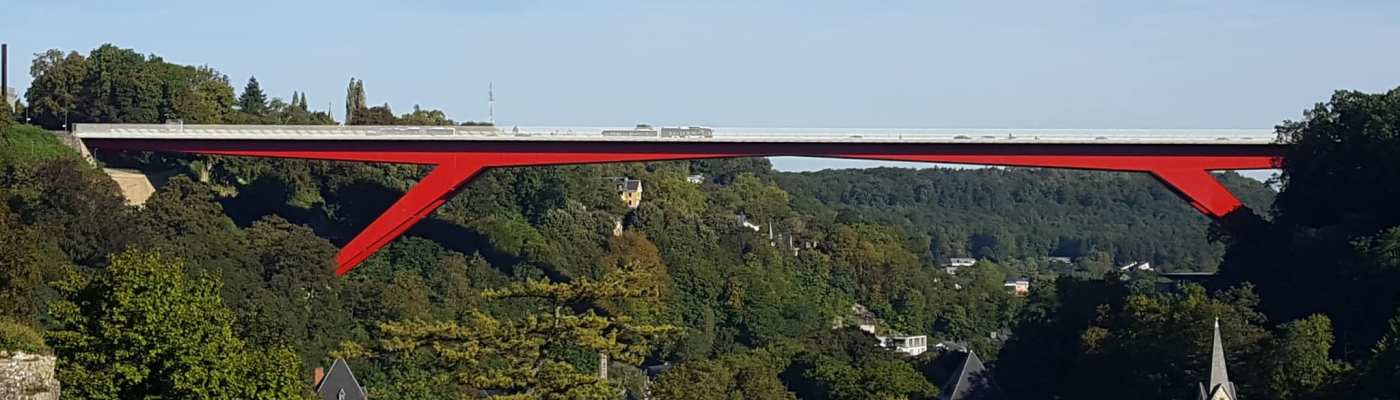
Another breathtaking viaduct leads to the Gare Centrale: from the parapet you can admire the green Petrusse valley, where a skatepark has been set up, reachable only on foot (or on skates). What the Luxembourgers call the “Roud Breck”, the Red Bridge, named after the Grand Duchess Charlotte, is impressive. Completed in 1966, 355 meters long, 25 meters wide, weighing approximately 4,800 tonnes, the bridge crosses the Alzette.
At its mouth there is a monument in honor of Luxembourger Robert Schuman, one of the pioneers of the European Community together with Alcide De Gasperi, Konrad Adenauer and Winston Churchill. A non-random location, because the Grand Duchess Charlotte bridge leads to the urban planning hub of the European Parliament. Indeed, Luxembourg is one of the three official seats of the EU and hosts its jurisdictional and financial institutions such as the Court of Justice of the European Union, the European Investment Bank, the European Court of Auditors. Indeed, a bridge city for Europe. #luxembourg #luxembourg #pontrouge #pontadolphe #europeanparliament
*
La Vieille Ville – la Città medioevale – e la Lussemburgo moderna sono collegate da una sistema di ponti e viadotti che hanno consentito, con soluzioni ingegneristiche ardite, di superare due corsi d’acqua (Alzette e Petrusse) che delimitano la città su tre lati. Sono una novantina le costruzioni aree che uniscono e raccordano i quartieri urbani. Cinque sono i viadotti, alti fino a 44 metri.
Spettacolare – pare una miniatura dei plastici ferroviari – quello che collega la città alta alla stazione ferroviaria: è scandito da 25 archi e si snoda per circa 300 metri di lunghezza in uno scenario da fiaba. Il “Ponte Adolphe”, entrato ormai nella iconografia della capitale del Gran Ducato, scavalca invece l’ampio parco sottostante attraversato dal fiume Petrusse. Costruito tra il 1900 e il 1903, finì al centro di polemiche perché considerato un’opera troppo ardita. Un altro viadotto mozzafiato conduce alla Gare Centrale: dal parapetto si ammira la verde vallata della Petrusse, dove è stato allestito uno skatepark, raggiungibile solo a piedi (o con i pattini).
Imponente quello che i lussemburghesi chiamano il “Roud Breck”, il Ponte Rosso, intitolato alla Granduchessa Carlotta. Terminato nel 1966, lungo 355 metri, largo 25, con un peso di circa 4.800 tonnellate, il ponte scavalca l’Alzette. Alla sua imboccatura c’è il monumento in onore del lussemburghese Robert Schuman, uno dei pionieri della Comunità Europea insieme ad Alcide De Gasperi, Konrad Adenauer e Winston Churchill. Una collocazione non casuale, perché il ponte Granduchessa Carlotta conduce al polo urbanistico del Parlamento Europeo. Infatti, Lussemburgo è una delle tre sedi ufficiali dell’UE e ospita le sue istituzioni giurisdizionali e finanziarie come la Corte di Giustizia dell’Unione europea, la Banca europea degli investimenti, la Corte dei Conti europea. Appunto, una città-ponte per l’Europa. #lussemburgo #luxembourg #pontrouge #pontadolphe #parlamentoeuropeo
 ROBERTO ALBORGHETTI
🩵
There are many sights worth seeing.
Yes, it is true. The world is a wonderful book where we can read and see fantastic things. Have a great Christmas and a Happy New Year!
Merry Christmas🎄🍷
Beautiful Luxembourg! 👌
Yes, you are right! I totally agree. Thanks and best wishes for Christmas and the New Year!
☺️thank you