
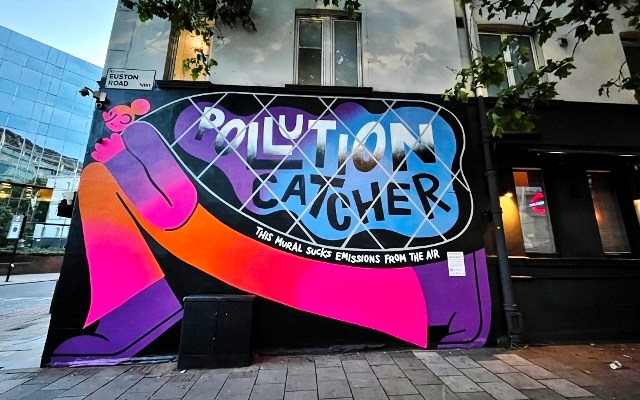
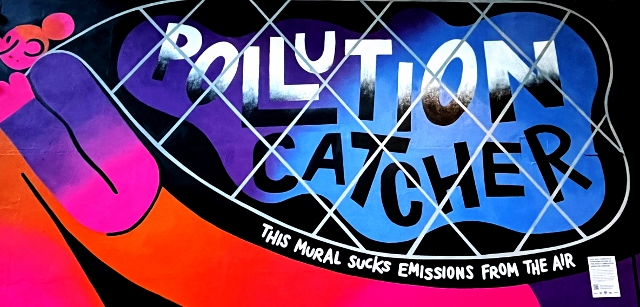
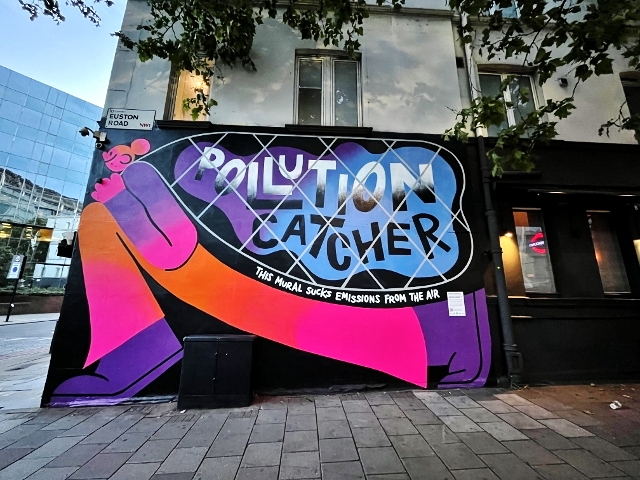
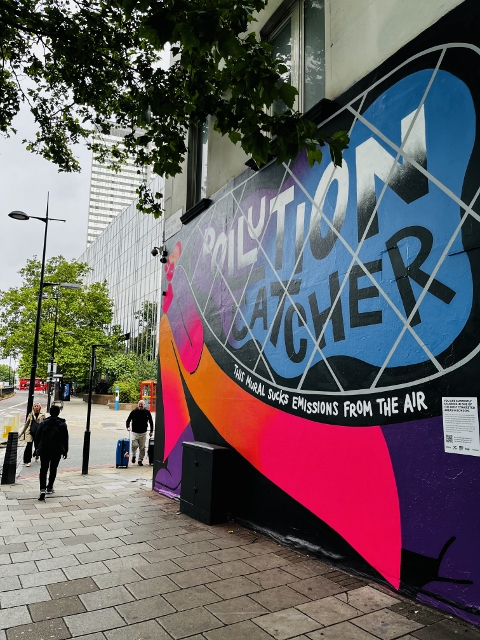
“You are currently standing in one of the most congested areas in London”. These words are written in block letters on a sheet glued to the wall, along Euston Road, in London. I look up and see that they accompany and explain a large colorful mural. I observe, read and discover that I am faced with something interesting.
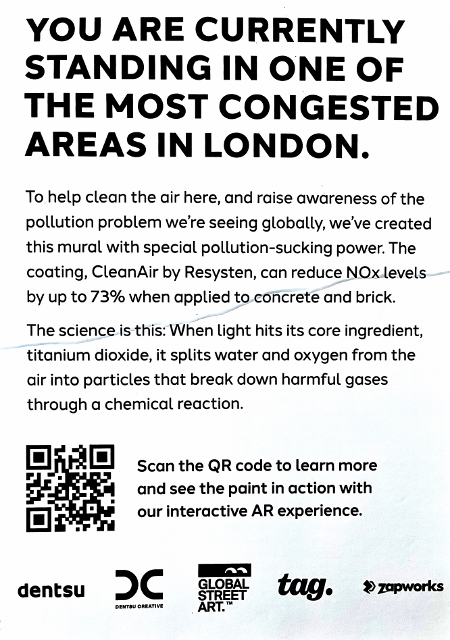
The text written on the white sheet states that “to help clean the air here, and raise awareness of the pollution problem we’re seeing globally, we’ve created this mural with special pollution-sucking power. The coating, CleanAir by Resysten, can reduce NOx levels by up to 73% when applied to concrete and brick. The science is this: when light hits its core ingredient, titanium dioxide, it splits water and oxygen from the air into particles that break down harmful gases through a chemical reaction”.
In the photo gallery of this post I publish the flyer in which a QR code is printed which, if viewed by your device, connects you to a page where you can find other interesting informations on this initiative which, we hope, can be adopted and increased also in many other cities where pollution levels are prohibitive. In short, we can say that artistic expression can really help improve the environment.
*
“In questo momento ti trovi in una delle zone più congestionate di Londra”. Queste parole sono scritte in stampatello su un foglio incollato al muro, in un punto di Euston Road, a London. Alzo gli occhi e vedo che accompagnano e spiegano un grande murale colorato. Osservo, leggo e scopro che mi trovo davanti a qualcosa di interessante. Il testo scritto sul foglio bianco riporta che: “per aiutare a pulire l’aria di questo luogo e aumentare la consapevolezza del problema dell’inquinamento che stiamo vedendo a livello globale, abbiamo creato questo murale che ha uno speciale potere di aspirazione dell’inquinamento. Il rivestimento CleanAir di Resysten può ridurre i livelli di NOx fino al 73% se applicato su cemento e mattoni. Questo il procedimento scientifico: quando la luce colpisce il suo ingrediente principale, il biossido di titanio, divide l’acqua e l’ossigeno dall’aria in particelle che scompongono i gas nocivi attraverso una reazione chimica”.
Nella fotogalleria di questo post pubblico il volantino in cui è stampato un QR code che, se inquadrato dal vostro dispositivo, vi collega ad una pagina dove si possono trovare altre interessanti informazioni su questa iniziativa che, ci auguriamo, possa essere adottata ed incrementata anche in tante altre città dove i livelli di inquinamento sono a livello proibitivo. Insomma, si può dire che davvero l’espressione artistica può dare una mano a migliorare l’ambiente.
 ROBERTO ALBORGHETTI
💙