

© Roberto Alborghetti
*
Where St. Peter’s now stands was once a chariot racing stadium, built in the time of the Emperor Caligula, Claudius and Nero (40-65). Among those first Christians to be rounded up by Nero’s soldiers was the leader of the Christian community in Rome, St. Peter the Apostle. He had probably come to Rome about the year 40 and was therefore about 25 years in the city. The stadium, about six hundred yards long, stretched from about the end of the Western wing of the Colonnade to well beyond the apse of the present basilica. St. Peter’s place of crucifixion is traditionally marked as corresponding to the left hand wing of the basilica, more or less where the altar of St. Joseph is today.
The tomb of Peter is still there, underneath the front of the Papal Altar and about 20 ft. below the floor level of the basilica. When Christians were eventually given their freedom (313), under the Emperor Constantine, after more than two hundred years of persecution, it was decided to build a basilica above the tomb of the Prince of the Apostles. Christians assembled frequently for worship. They needed increasingly large buildings – much larger than the tiny pagan temples of the past. Constantine saw to the building of a number of these “Basilicas” and especially to the largest of them which was erected above the tomb of Peter on the slope of the Vatican hill.
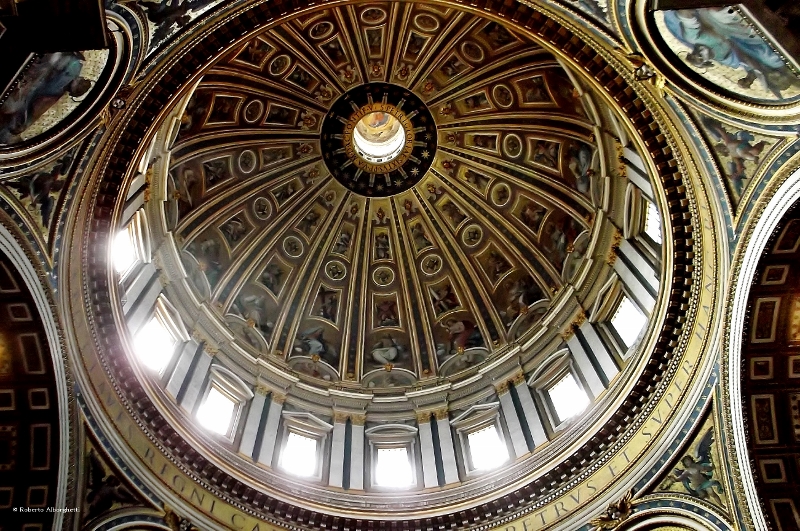
Michelangelo’s Basilica (1506-1626). That building lasted throughout the centuries until 1500. It was then in such a state of disrepair that Pope Julius II decided to replace it with a new and more magnificent structure. Work began in April 1506. Many great artists were involved in its construction and decoration: Bramante, Sangallo,Raphael,Michelangelo, Maderno, Della Porta, Bernini, Fontana. The most notable contributions, however, are those of Michelangelo, Maderno and Bernini. At the age of 72, in 1546, Michelangelo was obliged to undertake the building of the present Basilica by Pope Paul III. When he died, the construction of the Greek Cross section surrounding the Papal altar and the tomb of Peter had been completed only as far as the top of the drum: the large windows which are underneath the upturned bowl of the dome. The bowl itself, changed in shape from the half rounded shape of Michelangelo’s design to the half oval shape of today, was completed by Della Porta in May 1590. The Pope was Sixtus V.
Pope Paul V, in the beginning of the 1600’s, decided that the Greek Cross design was too small. He obliged his architect, Maderno, to pull down the front wall of Michelangelo’s building and extend the eastern end of the basilica by 116 yards. That was completed in 1626, and in the following 30 years Gian Lorenzo Bernini added the Colonnade.
The immense ten-acre spread of Bernini’s Colonnade is the pilgrim’s introduction to St. Peter’s. Its design incorporates a sun-dial, a calendar, and the welcoming arms of God’s embrace as He stretches out to receive all who come to pay their respects at the tomb of the first Pope. The obelisk in the center, as well as determining the time and the date by its shadow, takes us back in the millennia through the history of the old basilica, the Circus of Nero, the ship-building skills of the Romans who transported it across the sea from Alexandria in Egypt during the first century of the Christian era. It also takes us back through the centuries of the Pharaohs, perhaps to the Egyptian captivity of Israel.
(5 – End)
*
RELATED ARTICLES:
*
*
*
*
*
 ROBERTO ALBORGHETTI
Magnificent!
Thank you Debra!!!
breath taking!
Thank you so much!
Beautiful !!! :)*Cynthia
Thank you so much Cynthia!
Once again beautiful photos. What a privilege to enter St Peters as an invited guest
Thank you so much Lyn! Saint Peter Basilica is always an enchanting and amazing place to admire!
Thank You for liking my Painting!!! 🙂 *Cynthia